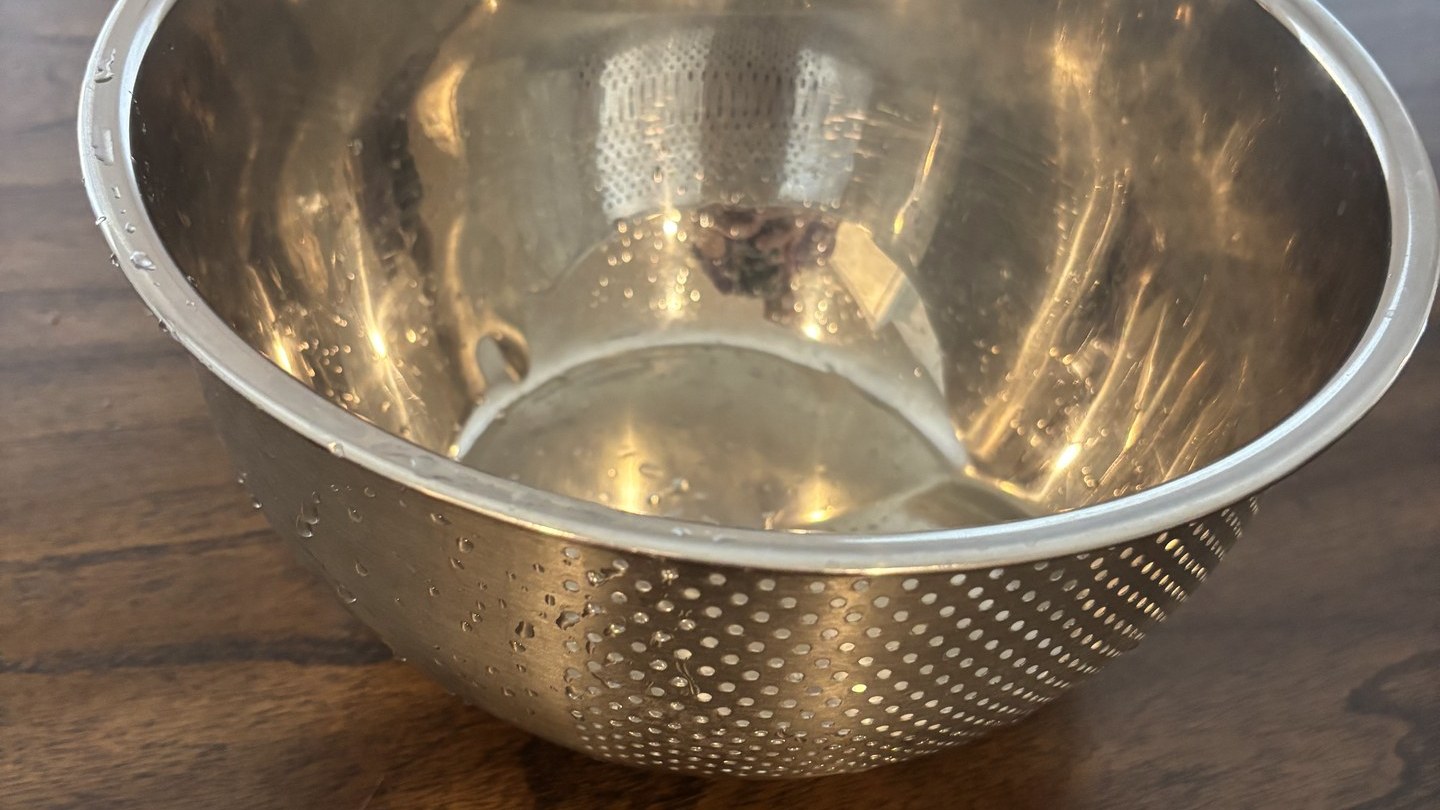
Rice washing bowls, compared by the only thing that matters: how the water leaves.
Four bowls with manufacturer specs and stable Amazon.com listings — three made in Japan, one designed on the Japanese pattern — by material, capacity and drain design.
If you haven't read why the colander is the problem, the short version: rice needs two or three rinses, the water has to leave fast, and the rice has to stay. All four below are designed to do that. They differ in what they're made of, how much rice they hold, and whether they drain from the side, the bottom, or both.
Not for you if…
- You cook rice once a month — a mixing bowl and patience are fine
- You want one bowl for rice, pasta and salad — a bowl with a built-in colander does that; these are rice tools first
- You cook for eight — the largest here is a 3-quart; big-batch cooks want a stockpot and a mesh strainer
Three things to compare
Drain design. Side slots let you tip and pour with the rice held back. Bottom holes drain the last of the water without tipping. Both together is the classic Japanese plastic design. Side-only is simpler and easier to clean.
Material. Polypropylene is light and shows scratches over years. The stainless bowls below are 18-8 from Japan's Tsubame-Sanjo region; stainless is heavier and more durable than lightweight plastic.
Capacity. Japanese makers rate bowls in gō — rice-cooker cups, about 180 ml each. "2 to 4 cups" is a family-of-four bowl. US makers rate in quarts; 3 quarts is roomy.
Side by side
Inomata Rice Washing BowlPP plastic · side slots + bottom holes
Not for: people who hate plastic; capacity isn't stated in cups.
Yoshikawa SJ364618-8 stainless · perforated walls · 2–4 cups
Not for: big batches — it's a 2-to-4-cup bowl. The dimensions are from the Amazon listing; Yoshikawa's page doesn't publish them.
Pearl Metal HB-676518-8 stainless · sloped base · 3-way
Not for: anyone who wants a rated capacity — the maker doesn't state one, and the dimensions are from the Amazon listing.
Helen's Asian Kitchen 97123stainless · 3 qt · side drainer
Not for: bottom draining — it's side-only, so you tip to finish.
Material, size and drain figures are from the manufacturers' pages (Inomata, Harold Import Co.), checked August 2026; items marked * use the Amazon listing's figures because the maker's page doesn't publish dimensions, and the card says so. Where a maker doesn't state capacity, the card says so. Spec-based comparison; I haven't cooked with each of these.
Which one, in one line each
No rush. The bowls will still be there next week.