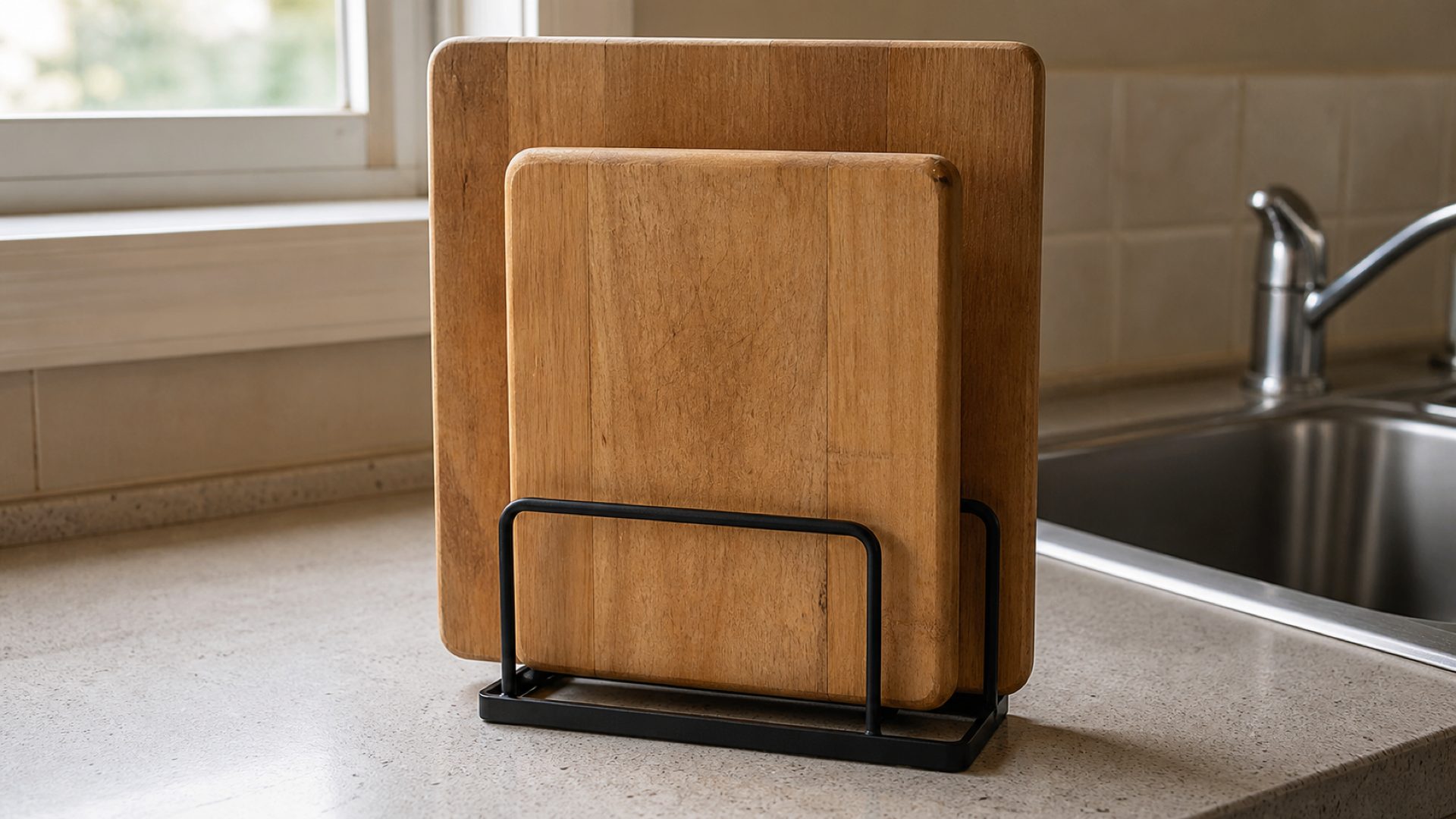
A Tokyo kitchen has no counter to dry things on. So things dry standing up.
Vertical board stands and compact, over-sink dish racks, the way Japanese apartments do it. Six with published specs and Amazon.com listings, compared by footprint and what they hold.
A dish rack the size of a carry-on, permanently wet, next to a cutting board lying flat on the counter with a damp underside.

Boards and lids go upright in a little steel stand. Dishes drain on a rack that folds flat or sits over the sink. When the counter is the length of your forearm, nothing gets to lie down.

A typical Tokyo studio is about 20 square meters — the whole apartment, not the kitchen. A US studio runs more than twice that, and a new US house gives the kitchen alone something like 300 square feet. Japan's kitchen tools were designed for the first number. Most of them are just as useful in an American apartment, and a few are exactly what a small US kitchen is missing.
Drying boards upright isn't only about space. Board makers say so: John Boos tells you to "let it air dry standing up to prevent water from pooling," and the University of Maine's food-safety extension recommends drying boards vertically because trapped moisture "can lead to the growth of microorganisms or mold." A wet board left flat traps moisture underneath.
Not for you if…
- You have a dishwasher and a 10-foot counter — you're fine
- You want one giant rack for a family's dishes — everything here is compact by design
- Your sink is wider than about 19 inches — the over-sink rack below has a limit; measure first
Three things to compare
Footprint. A board stand is under five inches square. A compact rack is about a foot by fifteen inches. An over-sink rack uses no counter at all.
What it holds. Stands take two boards or a board and a pot lid. Racks vary from "a few plates and glasses" to nine plates plus flatware.
Rust. Powder-coated steel is fine while the coating holds; stainless generally resists corrosion better. "Rust-resistant" on a spec sheet often means coated steel, so check the material line.
Side by side
Yamazaki Home Plate Cutting Board Standsteel · powder coat · silicone feet
Not for: thick end-grain blocks — 1 inch is the stated limit.
Yamazaki Home Tower Slim Over-Sink Rackcarbon steel · silicone tray
Not for: wide sinks or heavy pots — it's slim by name.
Yoshikawa Expandable Sink-Side DrainerSUS304 basket · SUS430 tray
Not for: anyone who wants a maker's spec page — figures are from the listing.
simplehuman Compact Steel Frame Dishrackstainless frame · silicone-capped wire
Not for: counters under 16 inches deep.
Umbra Sinkin Dish Rackcoated wire · polypropylene
Not for: big loads; single small sinks it won't fit in.
KitchenAid Compact Dish Rackstainless panels · coated wire
Not for: anyone who wants stainless all the way — the wire is coated steel; the size and weight are from the Amazon listing, because I found no manufacturer page for this rack.
Sizes, capacities and rust claims are from the manufacturers' pages (Yamazaki Home, simplehuman, Umbra), checked August 2026; items marked * use the Amazon listing's figures because the maker has no English product page, and the card says so. Spec-based comparison; I haven't tested these.
Which one, in one line each


No rush. The counter isn't getting any bigger.
Sources: Real Estate Japan, "Japanese apartment kitchens explained" (studio sizes); NAHB, "Spaces in New Homes" (kitchen area); Yamazaki Home, company story; John Boos, cutting board care guide; University of Maine Cooperative Extension, bulletin 3108e; manufacturers' product pages as listed above.