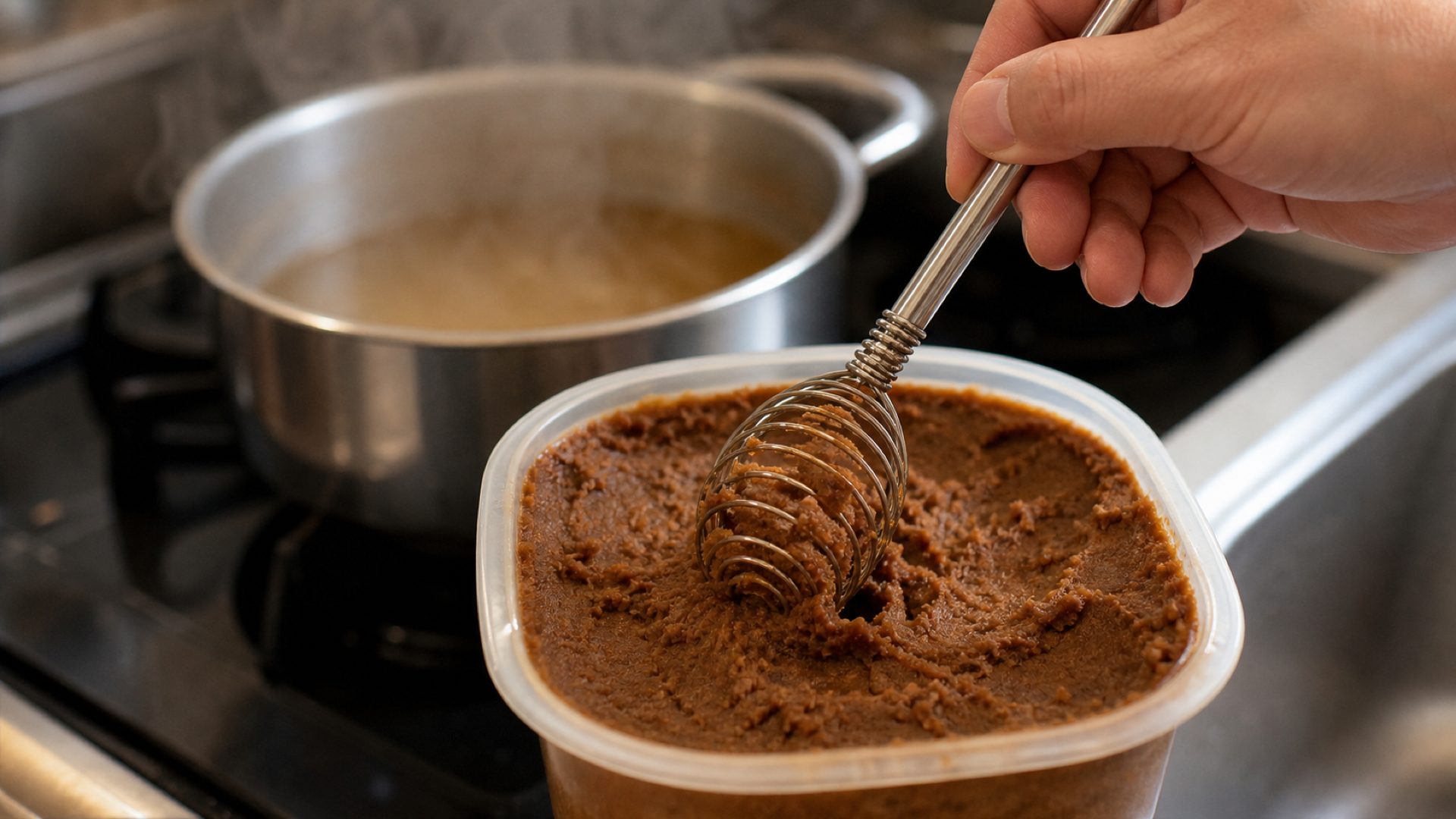
Miso muddler vs measuring spoon: one twist, two tablespoons, no scraping.
Miso is a sticky paste and a tablespoon is a flat scoop. Japan fixed that with a spiral on a stick. Four muddlers with published specs and Amazon.com listings, and when a spoon is still fine.
Dig, level with a knife, scrape it off into the pot with a second spoon, stir until the lumps give up. Every bowl comes out a little different.

Twist the spiral into the tub and it comes out holding a fixed amount — the large end is about two tablespoons on the original. Swirl it in the broth and the miso dissolves off the wire with no lumps and nothing to scrape.

Miso soup is daily food in Japan — in one 2024 consumer survey, about 35% of respondents said they use miso four or five times a week or more, and nearly 70% at least weekly. When you make something that often, the annoying step gets solved. The annoying step is the spoon.
The muddler is a stainless spiral, a different size on each end, on a handle. It was designed in Tsubame-Sanjo, the same metalworking region that makes Japan's kitchen knives and strainers. The idea is that a spiral of known volume grabs a repeatable amount of paste and, because it's open wire, lets the broth wash the paste off it when you swirl.
Not for you if…
- You make miso soup once a month — a spoon is fine; the muddler pays off at once a week
- You weigh everything on a scale already — the muddler is a convenience, not a precision tool
- You want a strainer too — some Japanese cooks push miso through a small mesh strainer (misokoshi) instead; there are sets that pair the two, and I note them below
The spoon isn't wrong. It's slow.
A Japanese rule of thumb is about one tablespoon (roughly 18 g) of miso per 200 ml bowl. That's easy to say and hard to level in a paste. Miso makers also tell you to add it at the end and not boil it — Marukome's own recipe says to return the pot to very low heat and "never let it boil after adding the miso" — which means you're dissolving cold paste into hot broth at the last minute, exactly when lumps are most annoying.
The muddler removes both problems: the spiral is the measure, and the swirl is the dissolve. It won't make the soup taste different. It makes the portion easier to repeat.
One more reason to measure: miso is salty. USDA data puts a tablespoon at roughly 630 mg of sodium, so "a bit more" three times a week adds up.
Side by side
Aux leye Miso Muddler LS150018-8 stainless · two spirals
Not for: anyone who wants a brand storefront — Amazon.com listings are from resellers.
Shimomura Mama Cook 3569418-8 stainless · one spiral
Not for: one-bowl portions — a single fixed scoop. Amazon lists it under model 34865; same dimensions.
UchiCook Miso Muddlerstainless wire spirals
Not for: anyone who needs the maker's own figures — the tablespoon amounts here are from the Amazon listing, not the maker.
Yoshikawa Ryouri no Iroha YJ277418-8 stainless · one spiral
Not for: anyone who needs a spec page — Yoshikawa doesn't publish one for this model; figures are from the Amazon listing.
Aux and Shimomura figures are from the manufacturers' product pages; items marked * use retailer-published figures because the maker has no product page, and the card says so. Checked August 2026. Spec-based comparison; I haven't tested these. Strainer-and-muddler sets on Amazon.com (wood muddler + mesh misokoshi) are mostly from brands with no manufacturer page, so I haven't linked one.
Which one, in one line each
No rush. The miso keeps.
Sources: Aux Co., leye miso muddler product page; Shimomura Kihan product page; Marukome USA, classic miso soup recipe; MyVoice consumer survey on miso use (2024, via PR TIMES); USDA FoodData Central sodium figure for miso; Just One Cookbook on the one-tablespoon rule (commentary source).