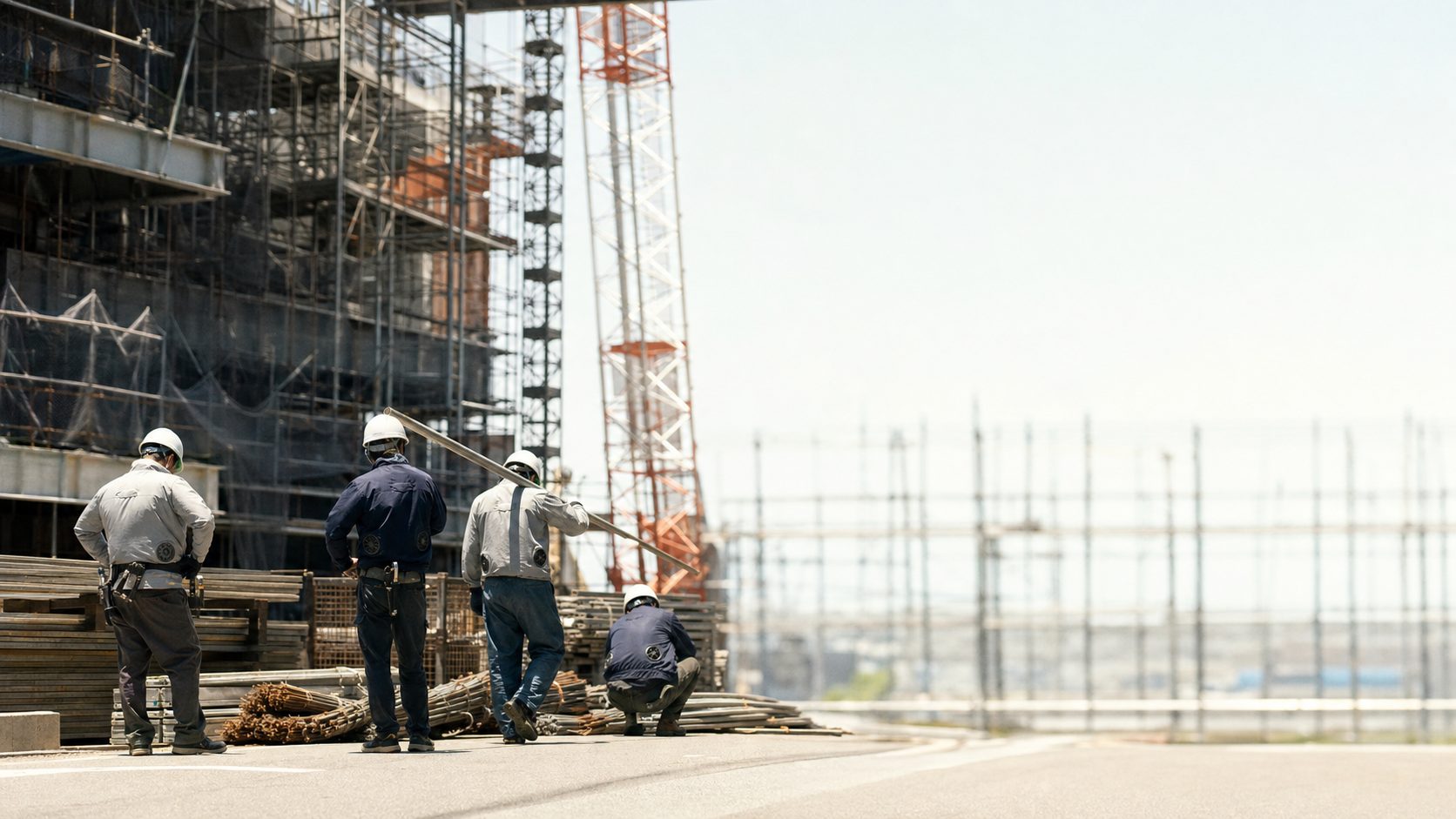
A Sony engineer wore a leaking jacket on the train for years. Then Japan changed how it works in summer.
Why fan jackets are standard on Japanese construction sites, why the idea took twenty years to reach the US, and what you can get in the US.
In 1999 a man named Hiroshi Ichigaya rode Tokyo trains wearing a jacket with a water tank on the hip, a pump, and fans. It leaked. He pinned a sign to it that said "Experiment in Progress" so people would stop staring.
Five years later the leak was gone, and so was the water. The jacket that finally sold in 2004 had nothing inside it but two small fans and a battery. Today, on Japanese construction sites in July, you see sleeves puffed up like a windbreaker in a gale. I'm Japanese, and I've watched them go from a joke to a uniform. Then I moved to Las Vegas, where it hits 110°F and few people I have met have heard of them.
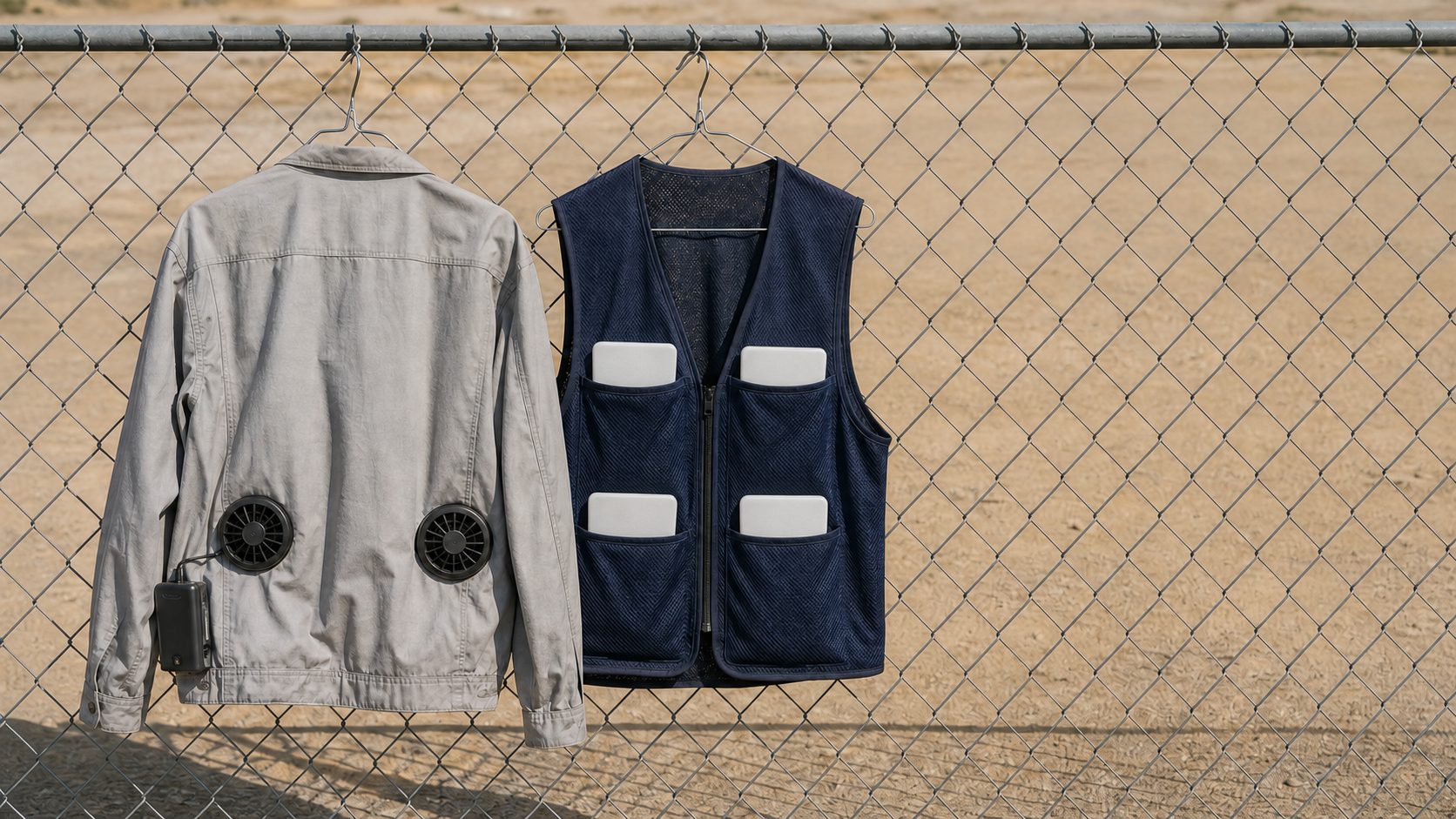
Ice-pack vests, neck fans, wet towels, and a cooler on the tailgate. Relief that lasts as long as the pack does — the PCM vests compared on this site publish two to three hours — then needs a freezer.

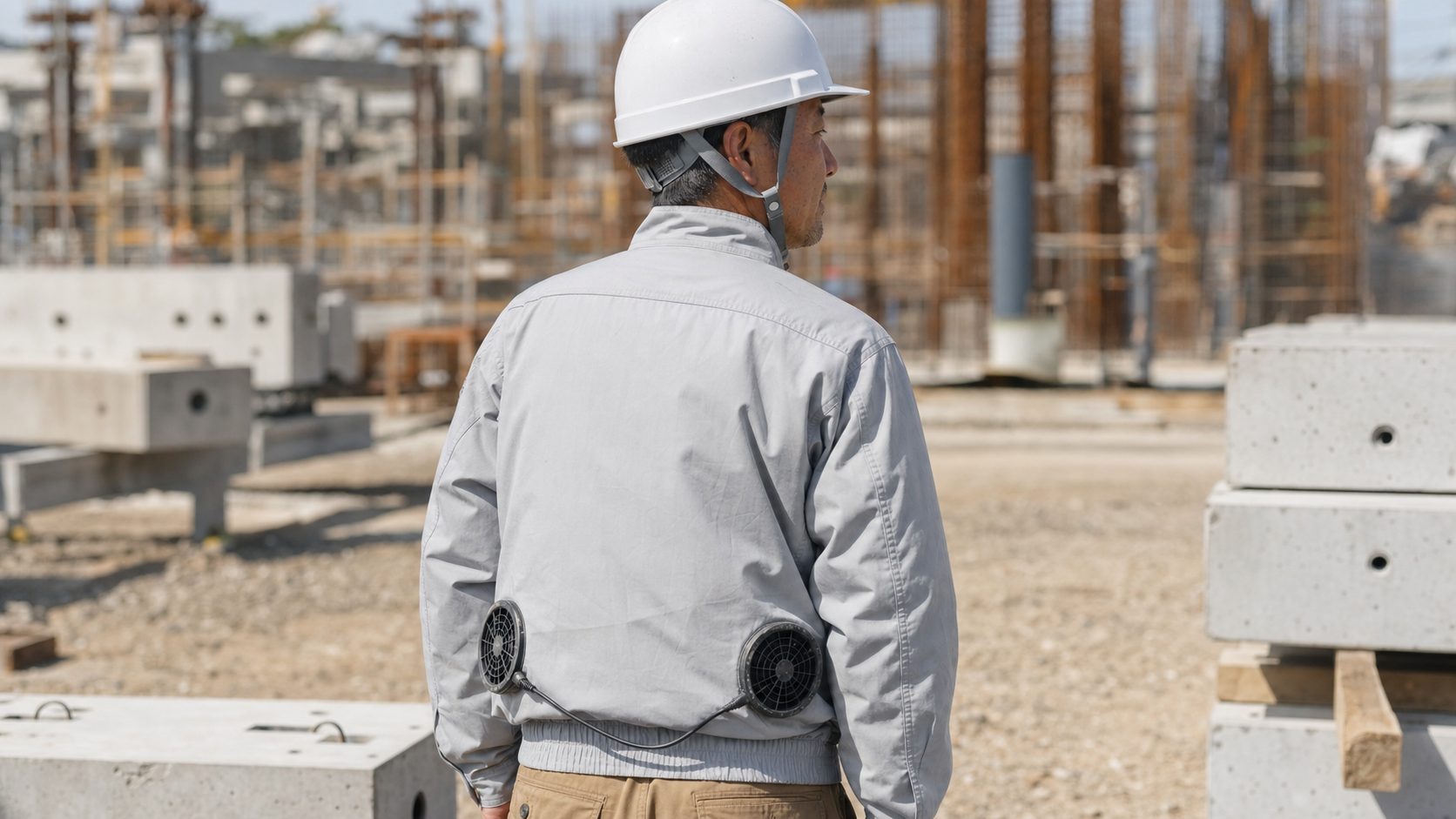
Two fans at the lower back pull air in. It runs across your shirt, out the collar and cuffs. Your own sweat does the cooling, all shift long.

The idea came from a construction boom, not a heat wave
Ichigaya had spent two decades at Sony, then left to build test equipment for TV factories. Selling it took him through Thailand and Malaysia in the 1990s, where skyscrapers were going up on every block. He did the math on how much power it would take to air-condition all of them, and didn't like the answer.
His fix was to flip the problem. Don't cool the room. Cool the person. A room needs kilowatts; a person needs a breeze.
The first prototype used water because that's how Japanese streets are cooled in summer — you sprinkle them. The second insight was better: people already sprinkle themselves. It's called sweat. If a garment could just move air across it fast enough, evaporation would do the rest. He called it "physiological air conditioning," tested more than a thousand fabrics to find one that didn't leak air, and shaped the fan blades to the millimeter to keep them quiet.
It flopped for ten years
Sales started in 2004 at around ten thousand jackets a year. For a country of about 123 million, that's nothing. People thought it looked ridiculous — because it does, a little, until you've worn one.
What changed wasn't marketing. It was farmers and site foremen telling each other. By 2016 the company sold 360,000 units in a year. Rival workwear brands piled in. In 2017 Japan's environment ministry gave the inventor an award for cutting CO2, because a small fan on a person replaces a lot of air conditioning. Today "fan jacket" is a category in Japanese hardware stores, with hi-vis versions, vests, hoods, and fans that spin faster than the first models ever did.
So why isn't this normal in America?
Three reasons, as far as I can tell.
The US solved heat with ice. Cooling vests here are mostly frozen packs or phase-change inserts. The PCM vests compared on this site publish two to three hours, then need a cooler. That's fine for a lot of jobs. It's not fine for an eight-hour shift in Nevada.
The originals never really shipped here. Kuchofuku, the company Ichigaya founded, and Burtle, one of Japan's biggest fan-jacket brands, both sell mainly in Japan. When I checked in August 2026, neither had a live listing on Amazon.com. What did make it across is the idea, carried by a power-tool company.
It looks funny. It looked funny in Japan too. That objection lasted about a decade there.
What you can actually buy here
The clearest bridge is Makita. Their DFJ-series fan jackets are the same idea, built to run on the 18V batteries that are already in a lot of American garages. There's a cotton one, a hi-vis one rated ANSI 107 Class 3, and one with zip-off sleeves. AlphaCool sells a lighter 5V version with the battery in the box.
I compared them by the numbers that matter — runtime on high, whether a battery is included, hi-vis rating, and whether the fans come out for washing — in the article below. It's a spec-based comparison from the manufacturers' numbers; I haven't lab-tested any of them.
No rush. The jackets will still be there next week.
Sources: nippon.com, "Cool Innovation: The Story of Air-Conditioned Clothing" (2022); Government of Japan, Highlighting Japan, "Cooling the Body with Fan-Equipped Clothes" (Aug 2021); WIPO IP Advantage, "KUCHOFUKU Cooling Fashion" (2026); The Guardian, "The fan jacket" (Jul 2023). "空調服" is a registered trademark of Kuchofuku Co., Ltd. and SFT Laboratory in Japan; this article uses "fan jacket" as the generic term.