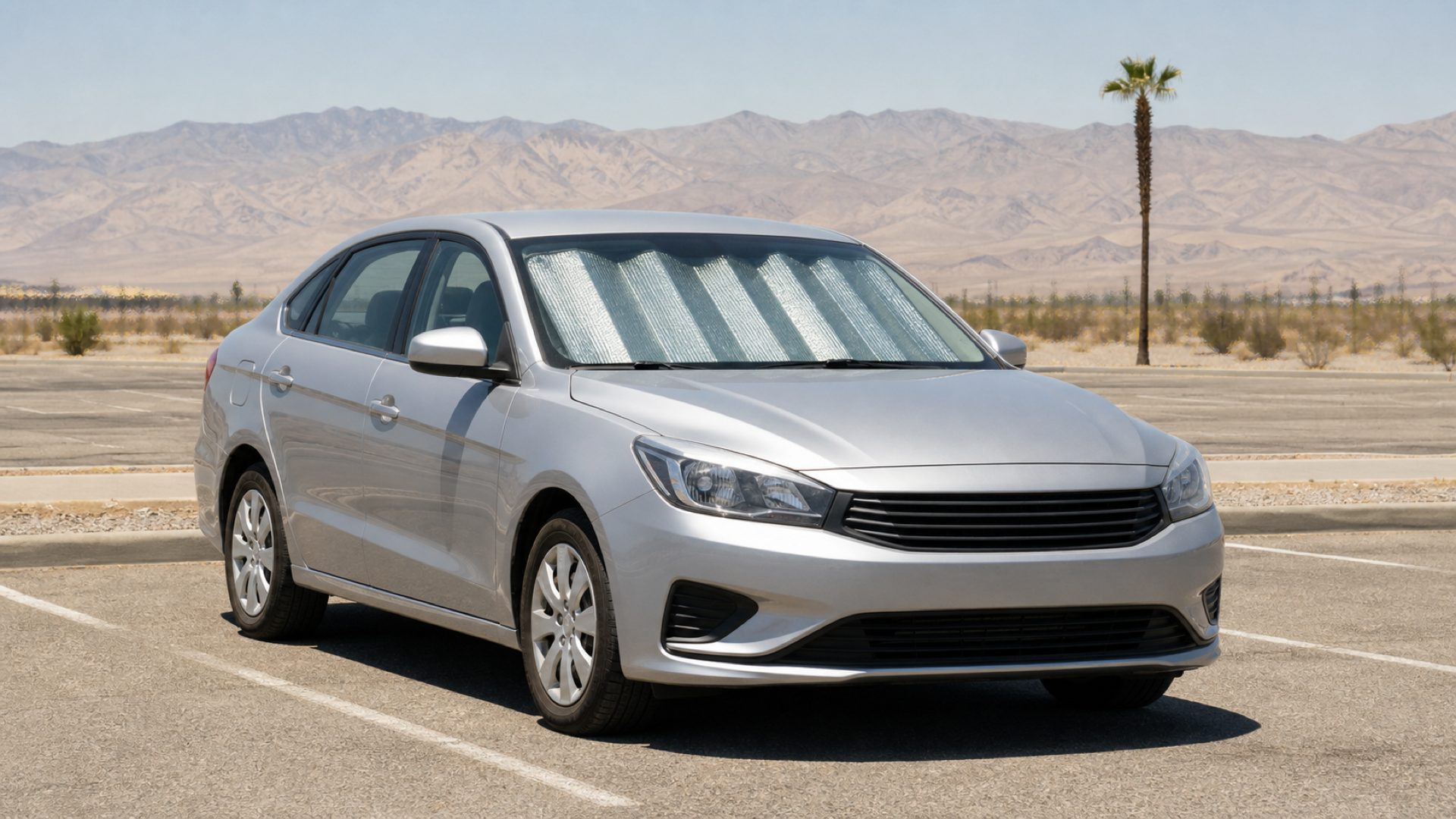
Japan's auto club measured what a sunshade does. The dashboard went from 79°C to 52.
A parked car in Las Vegas is an oven with a steering wheel. Here's what one well-known Japanese test found, and five sunshades with manufacturer specs and Amazon.com listings, from folding universal to laser-cut custom.
Remote start, cracked windows, a towel on the seat, and grabbing the steering wheel with two fingers. Sunshades exist, but half of them stay in the trunk.
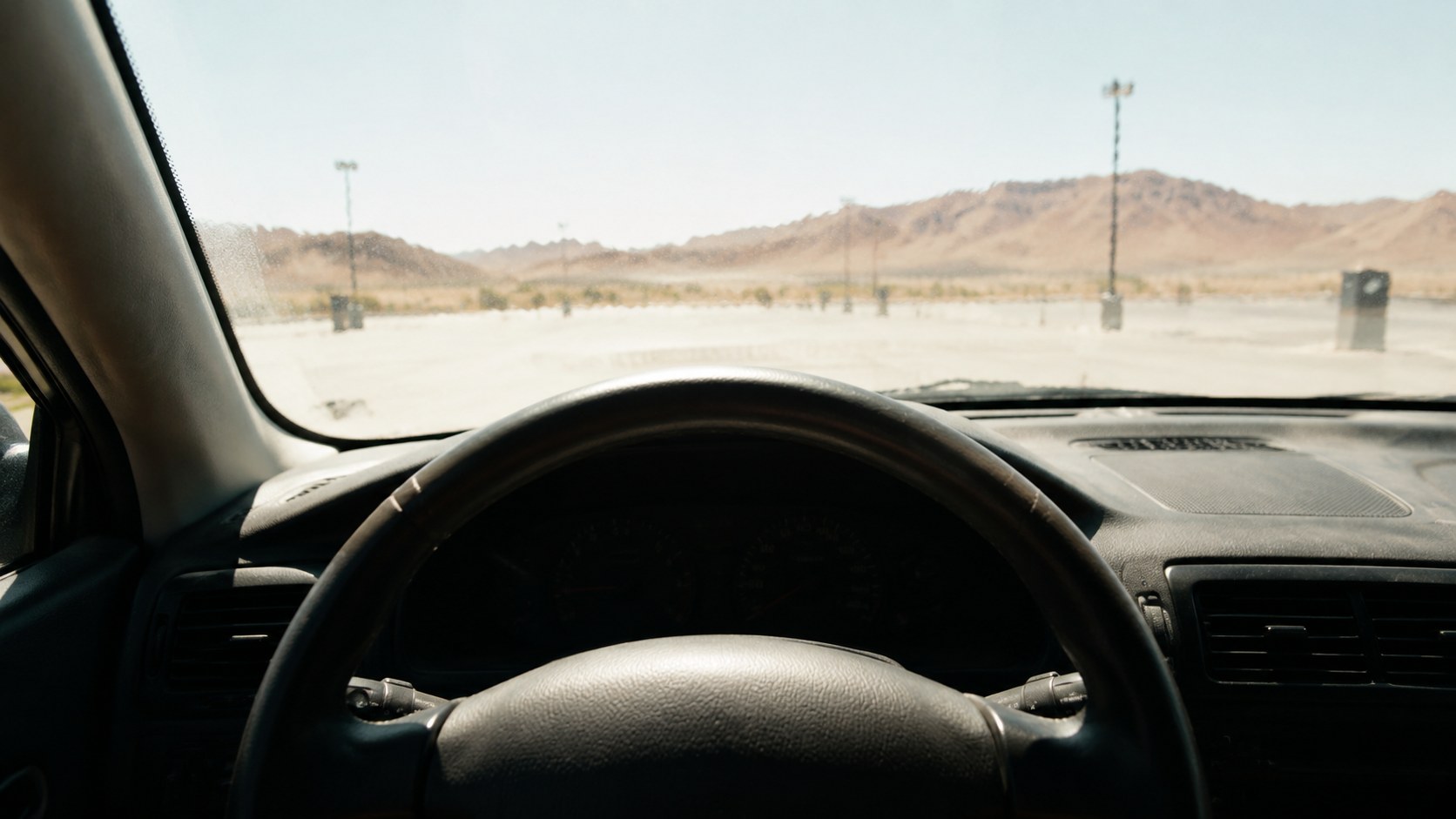
In summer the sunshade goes up in parking lots across Japan, and the auto club runs the numbers to prove why. Japanese makers sell folding, pop-up and umbrella-style shades; most of them never reach Amazon.com, but the idea does.
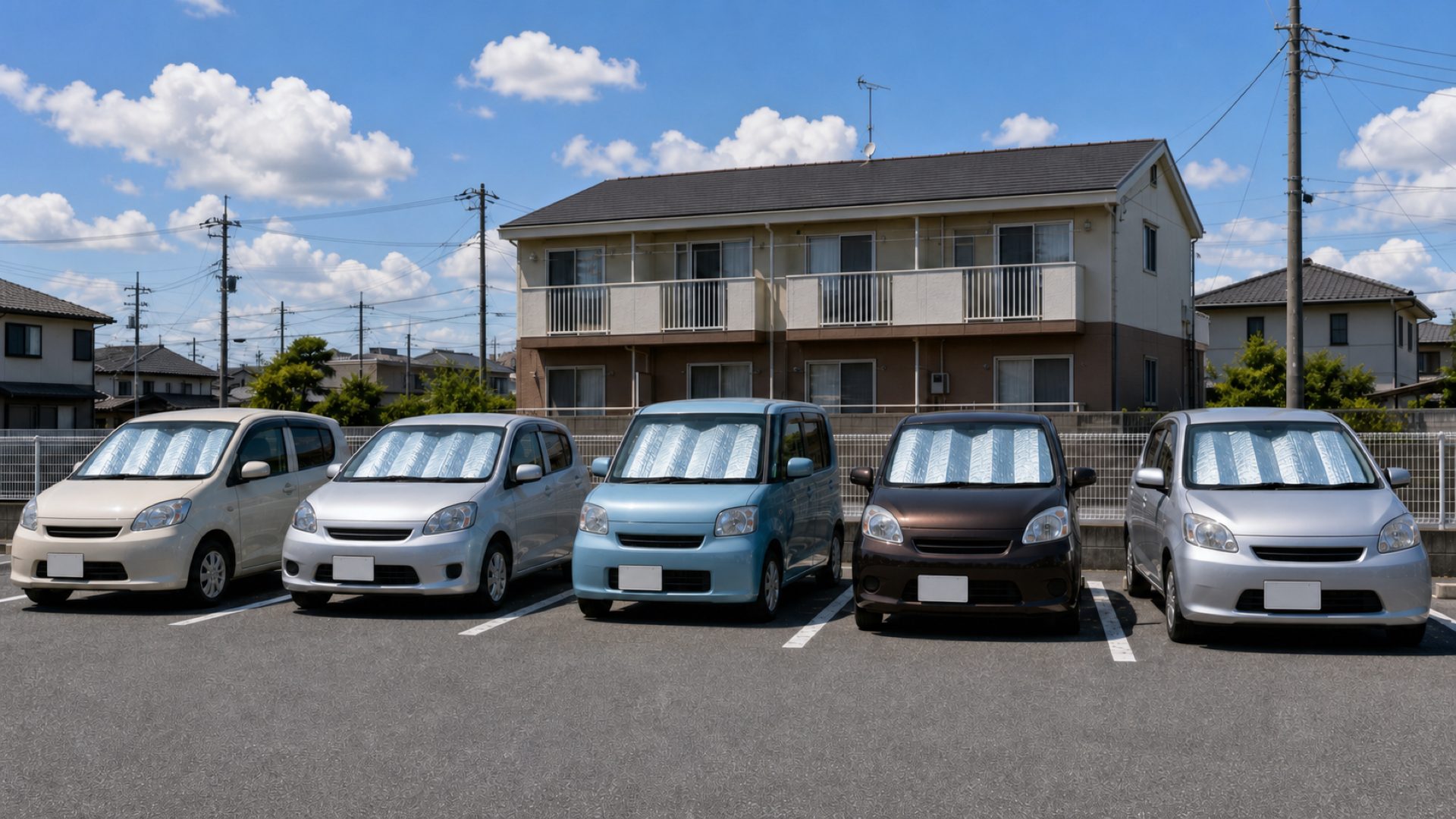
JAF, Japan's equivalent of AAA, parks cars in the sun and measures them. In its summer test, at 35°C (95°F) outside, a black car with nothing done to it reached a cabin peak of 57°C (135°F) and a dashboard peak of 79°C (174°F). The same setup with a windshield sunshade: cabin 50°C, dashboard 52°C. The sunshade barely moved the air temperature. It took 27°C off the dashboard, which is the part you touch and the part that keeps radiating heat after you get in.
Las Vegas is hotter than that test. The normal July high here is 104.5°F, and NHTSA notes a car's interior can rise 20 degrees in as little as ten minutes. Even with a shade, JAF still measured a 50°C (122°F) cabin — a shaded car is never safe for a person or a pet. So the question isn't whether to use a shade. It's which kind you'll actually put up every time.
Not for you if…
- You park in a garage at home and at work — the shade will live in your trunk
- You need the whole car done, not just the windshield — the custom brands below sell multi-window kits; the universal ones don't
- You expect the cabin to feel cool — the JAF numbers say a shade protects surfaces far more than air; that's still worth it
Three things to compare
Universal vs. custom-fit. A universal fold-up shade costs less and fits "most" cars, which means gaps at the edges. A custom shade is cut to your year, make and model, so edge gaps shrink, and it is stiff enough to stay up without the visors. The custom ones are also heavier and bulkier folded.
Material. The universal shades below are polyester (the "T" number is the weave density — 210T or 240T is denser than the 170T many basic ones use) with a reflective coating. Custom shades use a foam core with a reflective laminate, which is why they hold shape. Nothing here is a measured comparison of how much heat each blocks.
What goes back in the trunk. A fold-up in a pouch goes in a door pocket. A custom shade is a 40-inch accordion that needs the back seat or the trunk. Think about whether you'll do that twice a day.
Side by side
EcoNour Windshield Sunshadefold-up · 240T polyester · silver
Not for: a perfect edge seal — it's universal. EcoNour's "blocks 99% heat" is a marketing claim with no test method stated.
Kinder Fluff Windshield Sunshadefold-up · 210T polyester
Not for: anyone who wants a temperature figure — Kinder Fluff doesn't publish one.
Intro-Tech Ultimate Reflectorcustom-fit · multi-layer · reversible
Not for: anyone who wants a weight or folded size before buying — Intro-Tech doesn't publish them. "Up to 40°F" cooler is the maker's own claim.
WeatherTech SunShadecustom-fit · foam core · reversible
Not for: anyone who wants specs up front — WeatherTech says they vary by vehicle and to call.
Covercraft UVS100custom-fit · triple laminate · felt back
Not for: people who want the storage bag included — it isn't.
Material, fit and folded-size figures are the manufacturers' stated values (EcoNour, Kinder Fluff, Intro-Tech Automotive, WeatherTech, Covercraft), checked August 2026. Temperature-reduction claims are the makers' own and are labeled as such. Spec-based comparison; I haven't tested these.
Which one, in one line each
The ones Japan has that you can't buy here
Japanese brands like Seiwa, Carmate and Meltec sell pop-up shades and umbrella-style shades that open like a parasol and fold to a tube. They're clever, and common in Japan. When I checked in August 2026, none of them had a stable Amazon.com listing, so there are no links. If one shows up, I'll add it. And if you see an "umbrella car sunshade" on Amazon.com from a brand with no website, that's the idea, minus the spec sheet.

No rush. The car will still be hot next week.
Sources: JAF (Japan Automobile Federation) user test, "Car interior temperature in summer" (35°C ambient, 4-hour test); NHTSA, National Heatstroke Prevention Day release; NWS Las Vegas temperature normals; manufacturers' product pages as listed above.